New AI feature announcements are flooding the market, our inboxes, and our LinkedIn feeds.
From the dramatic “The ATS is dead” hyperbole to the seemingly random capabilities that make you ask: “What does that really solve for?”, it’s a confusing time for the customers our industry serves.
And, not only is it confusing due to the rapid pace of change and vague information, but also because of the way vendors and buyers alike have approached product strategy.
Table of contents
George LaRocque puts it beautifully in this article: “It’s time to ditch the checklists.”
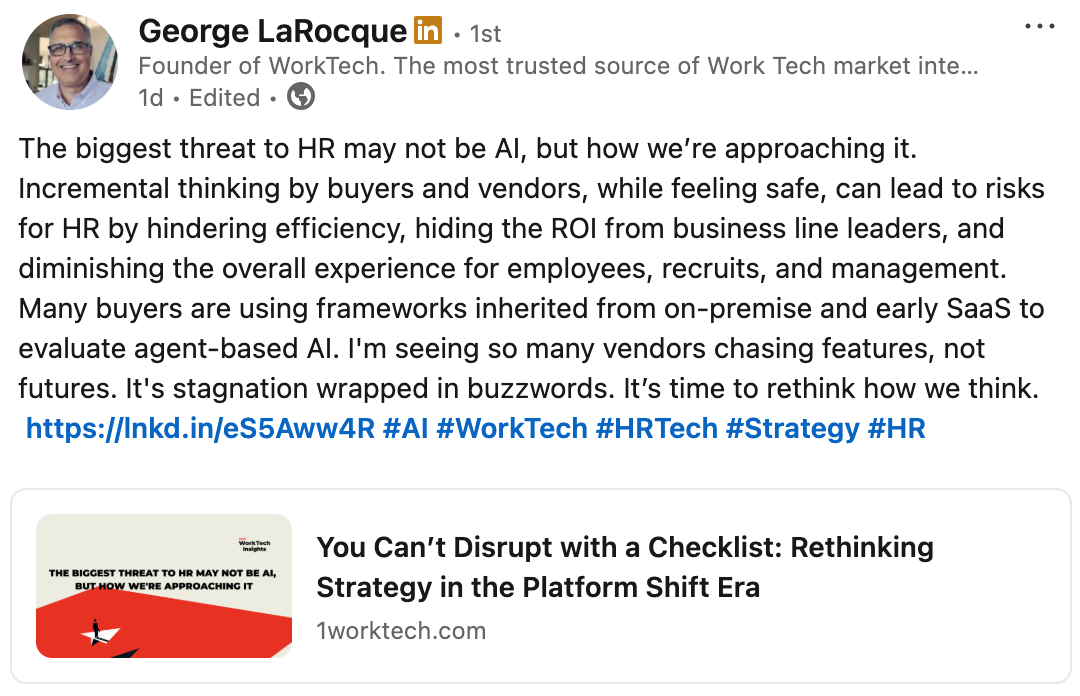
For too long, vendors and buyers in HR tech have used the ‘feature checklist’ as a comparison baseline.
It hasn’t been effective and is essentially worthless now, as everything is now a nail, and AI is the perceived hammer.
In a slight deviation from my typical hiring-focused newsletter, George’s article inspired me to share how we’re thinking about AI at Spark Hire – and honestly, how I believe YOU should be thinking about it too.
Our Fundamental AI Beliefs
Of course, we have AI principles and an AI Framework guiding our controls around AI, but that’s how we go about building. Our fundamental beliefs are what guide what we decide to actually build.
1. Our customers are not hiring with AI, they’re using AI to hire.
This underscores the notion that AI should support, not replace, human judgement in hiring.
2. AI should be used to highlight what matters.
There’s been a lot of chatter about candidates and employers being “AI adversaries”. Everyone in the hiring process is AI-enabled and that’s a good thing, if AI is used for what matters.
3. Problem-first, not feature-first.
Spark Hire AI is rooted in solving the most impactful and relevant hiring problems for our ideal customer. We’re not building AI features for efficiency’s sake or to win a checklist battle with other vendors.
For our Ideal Customer Profile (ICP), there are two primary thematic challenges plaguing their hiring processes. Those are screening and selection, and collaborating with their hiring managers.
Will these always be the top challenges for our ideal customer? Probably not; at least we hope not.
But my point is that these fundamental beliefs can guide your strategy and provide focus, while still allowing us to be flexible and agile so we can adapt for our customers if the landscape shifts.
Our Strategic Narrative
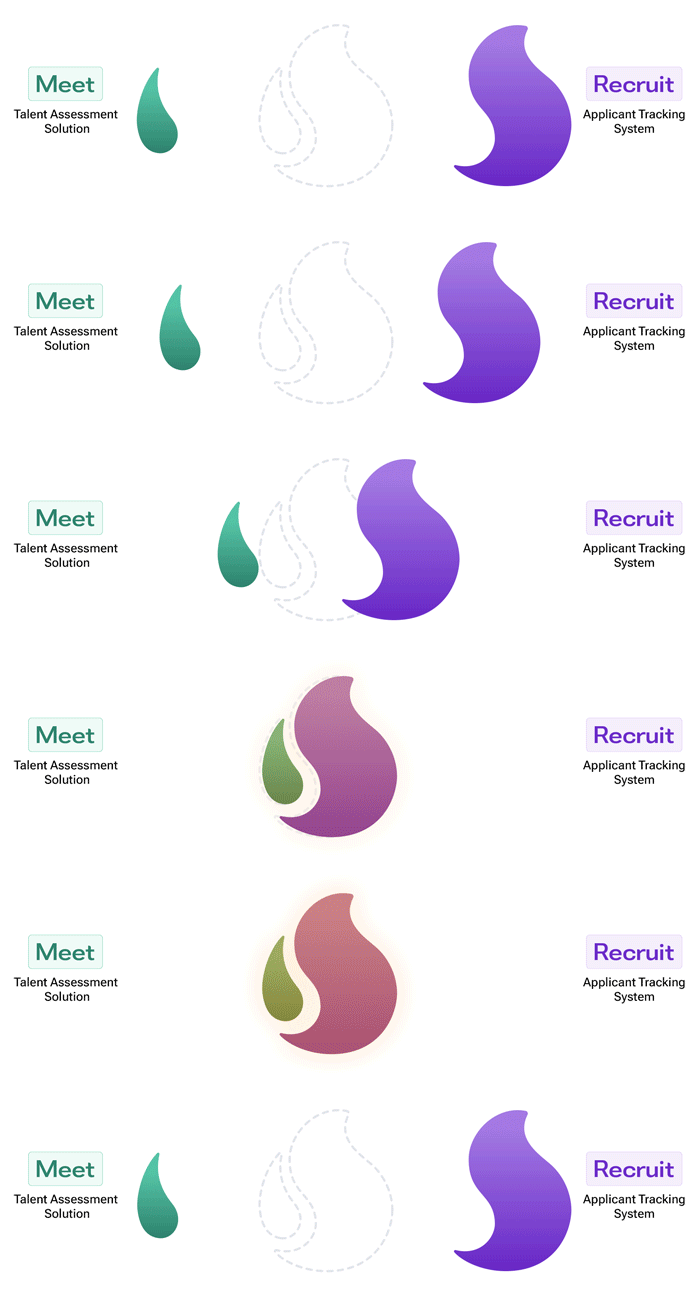
Some context before jumping in: if you’re not familiar with Spark Hire, our hiring software consists of 2 core solutions: Meet and Recruit.
- Meet is our talent assessment solution consisting of video interviews, our Predictive Talent Assessment, and automated reference checks.
- Recruit is our applicant tracking system which comes with all assessment functionality from Meet.
- We’re unique in that you can use Meet on its own or as part of Recruit.
Alright, back to today’s discussion…
On top of our fundamental beliefs, we align our product roadmap to ensure that AI features aren’t shipped at random, but as part of our greater strategic narrative for what Spark Hire AI is.
Compounding Features
Because of our problem-first prioritization, Spark Hire AI features not only compound the value of each other, but also of non-AI features across our solutions.
For example:
- AI-generated job descriptions ➝ lead to
- Better interview questions ➝ evaluated using
- More accurate scorecards ➝ supported by
- Meaningful AI-generated summaries
These features are built to work together, helping hiring teams make more confident, fair, and faster hiring decisions, rather than solving one singular problem.
Meet + Recruit
Our secret sauce with Spark Hire AI is our unique ability to not only compound the value of features within Meet or Recruit, but also that Spark Hire AI spans across Meet and Recruit.
For instance, AI-generated summaries in Meet are accessible via Recruit.
So, when you use Meet and Recruit together, you’re able to utilize Spark Hire AI to the fullest, across your entire hiring process.
This interconnected system differentiates Spark Hire’s positioning from other vendors offering standalone, isolated features and/or third-party integrations.
A Clear Visualization of Our Framework
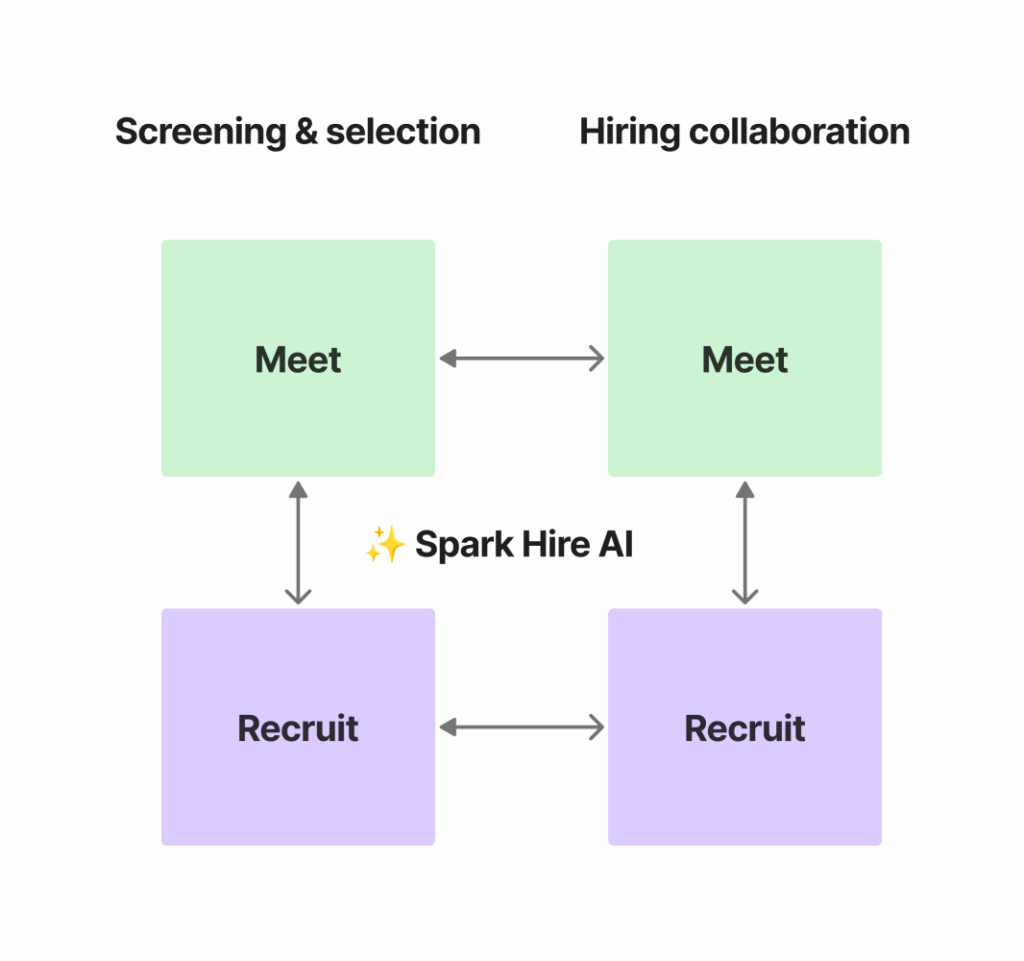
Vertical Buckets: What are the problems we’re looking to solve?
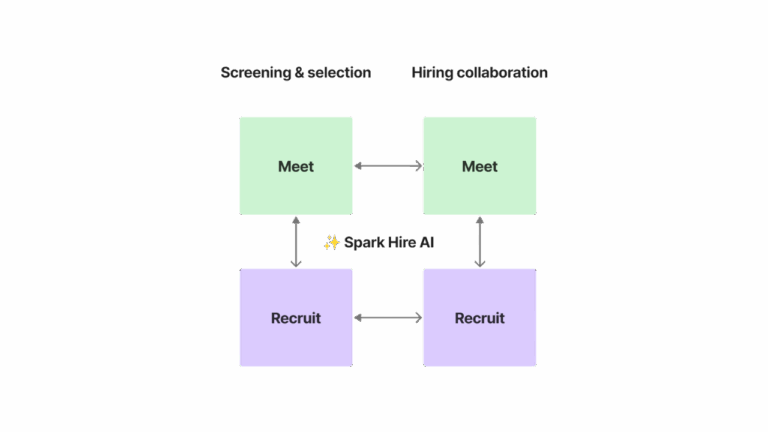
To visualize everything I’ve noted above, we physically map our AI features to core problem areas in hiring:
- Screening & Selection
- Hiring Collaboration
Each vertical bucket represents a distinct hiring challenge Spark Hire aims to solve with AI.
Horizontal Layers: How do these features integrate across Meet and Recruit?
“Horizontal compounding” is how our AI features across Meet and Recruit interoperate and amplify one another (along with non-AI features).
Here’s what this practice looks like:
Final Thoughts
Part of writing this was to give you all an inside look at what’s going on in the mind of an HR tech CEO.
Part of writing this was to heat check Spark Hire’s AI narrative, how we like to refer to this strategic approach in-house, to see if it resonates.
But, the biggest part of writing this piece is to share that we have an opinion – a public opinion.
And, I think that’s what matters.
No random acts of AI. No curtain hiding how we’re thinking about it now and as we move forward.
Stay tuned to see how this plays out!